Venue Operator Brief — May 2026

The intelligence
layer for hospitality.

Vibe combines proprietary multi-sensor hardware, a consumer discovery app, a venue dashboard, an embedded payment rail, and a gamified social layer into a single operating system. One platform, three data layers, one source of truth.

6
Integrated systems
3
Data reality layers
~4h
Sensor install
Live · The Brisbane Rooftop
22:14
Inside now
147
↑ 22 in last 30m
Avg dwell
1h 42m
+18% vs last Fri
Footfall tonight
Verified visits today 312 / projected 480

Hospitality operates blind.

POS data tells you what was sold, not who came in. Door counters tell you how many, not who, where, or why. Reservation systems capture intent, not behaviour. Loyalty apps capture identity, not presence. And none of them talk to each other.

The result: every venue runs on intuition dressed up as data.

~80%
of in-venue customer behaviour goes unmeasured by the average operator
$0
attribution between marketing spend and what actually happens on the floor
3+
disconnected systems the average venue operator stitches together to answer one question
24h
typical lag between something happening on the floor and the operator finding out

Six systems.
One operating system.

Each system stands alone. Together, they form a closed loop: presence verifies intent, intent drives spend, spend funds rewards, rewards drive return visits.

01

Data Apparatus

Proprietary multi-sensor hardware (mmWave, WiFi CSI, UWB, BLE) that measures presence, dwell, group size, and zone-level movement in real time — without identifying individuals.

Layer · Physical reality
02

Vibe App

The consumer surface. Real-time discovery — what's busy, what's quiet, what fits the mood — paired with sensor-verified check-ins and a social graph anchored in actual co-presence.

Layer · Intent reality
03

Venue SaaS

The operator dashboard. Live floor intelligence, zone heatmaps, conversion analytics, customer cohorts, marketing attribution, and Challenge sponsorship — all in one surface.

For · Venue managers & owners
04

Vibe Card

A dual-rail (prepaid + credit) consumer card issued to app users. Captures economic reality alongside presence — closing the loop between who came, what they did, and what they spent.

Layer · Economic reality
05

Challenges

Sensor-verified gamified objectives. Solo, social, or venue-sponsored. Venues fund rewards directly through the SaaS to drive specific behaviours — mid-week traffic, off-peak dwell, new-product trial.

Drives · Verified return visits
06

Dating

Sensor-verified co-presence matching. The same hardware that powers analytics turns Vibe into the only social product where matches are anchored to real-world reality, not curated photos.

Reuses · Sensor verification
The closed loop

How the systems compound

DISCOVER App suggests Real-time matches VERIFY Sensor confirms Customer arrives ENGAGE Challenge unlocks In-venue activity SPEND Card transacts Revenue + interchange MEASURE SaaS reports Operator acts RETURN Loop tightens Smarter targeting data feedback loop

What you see on opening night.

The dashboard is built for two roles: the operator on the floor making minute-by-minute decisions, and the owner asking strategic questions of the week, month, and year.

Live floor view
Zone-level occupancy, dwell, and queue dynamics in real time.
Customer cohorts
First-timers, returners, high-spenders — surfaced automatically.
Conversion attribution
Tie marketing spend, app discovery, and Challenges to actual visits and spend.
Sponsor a Challenge in 30 seconds
Drive specific behaviour — quiet Tuesdays, new menu trial, group bookings — from the same surface.
vibe.app/venue/the-rooftop
2026.05.09 · 22:14
Inside
147
↑ 22
Capacity
73%
200 cap
Avg dwell
1:42
↑ 18%
Card spend / hr
$4.8k
↑ 11%
Footfall · Last 12h
10:00 → 22:14
Zone heatmap
BarStagePatio
Live alert
Bar zone hit 95% capacity — patio at 41%
Cohort signal
37 first-time visitors via app discovery
Challenge
"Try the new spritz" — 12 completions tonight

From handshake to live data
in 5 days.

No floor closure. No customer disruption. No POS surgery.

DAY 0–1

Site walk + sensor mapping

One of our hardware engineers visits the venue, maps zones, identifies sensor placement, confirms WiFi/power requirements, and produces the install plan. ~90 minutes on site.

What we measure
  • · Floor zones (bar, dance, seated, patio, queue)
  • · Capacity and bottleneck choke points
  • · WiFi coverage + power point access
  • · Existing POS / booking integrations
DAY 1–2

Hardware install

Sensors are installed during off-hours — typically 4 hours, no service disruption. Discreet ceiling/wall mounts. No cabling changes. We connect to your existing WiFi or run a private mesh.

Sensor stack
mmWave radarPresence + dwell
WiFi CSIDensity + flow
UWB anchorsZone-level position
BLE beaconsApp handshake
Anonymous by design. No facial recognition. No camera feeds.
DAY 2–4

Calibration + onboarding

48 hours of automatic calibration against your real foot traffic. Meanwhile your manager and team are onboarded to the dashboard, alert preferences, and Challenge tooling.

Onboarding includes
  • · 60-min dashboard walkthrough with your team
  • · Custom zone naming + alert thresholds
  • · Marketing channel attribution setup
  • · First Challenge designed with your manager
DAY 5

Live + ongoing

Dashboard goes live. App listing activates. Customers see your venue in their feed. We check in weekly for the first month, then monthly. Hardware health, software updates, and feature releases are handled by us.

From day 5, you have
  • ✓ Real-time floor intelligence
  • ✓ Customer cohort analytics
  • ✓ Marketing attribution
  • ✓ Challenge sponsorship tools
  • ✓ Card transaction enrichment
  • ✓ Weekly executive summary report

Three layers of reality.
One identity graph.

Each layer of the platform produces a different kind of truth. Owning all three on the same identity graph — in real time, with sensor-grade verification — is what makes Vibe structurally defensible.

Physical reality
Sensors

Who's here. Where they are. How long they stay. How they move. Ground-truth presence, anonymously measured, in real time.

Intent reality
App + Challenges

What they were looking for. What they planned. What they shared. What Challenges they completed. The why behind the where.

Economic reality
Card

What they actually paid for. Basket structure. Frequency. Lifetime value. The economic truth of the visit.

Layer 03 · Economic
VIBE CARD
$48 spent · 3 venues · Tuesday
Cocktails
$24
Food
$18
Cover
$6
Layer 02 · Intent
APP + CHALLENGES
Looking for a quiet wine bar
Searched · Saved · Shared with 2 friends · Challenge accepted
·intimate ·natural wine ·post-work
Layer 01 · Physical
SENSORS
Arrived 19:42 · Stayed 1h 18m
Group of 2 · Bar zone → Patio → Bar

three signals · one identity

No competitor owns more than one layer

The structural advantage

Placer.ai
Physical (mobile data)
Intent
Economic
me&u / Spots
Physical
Intent (orders)
Economic (transactional)
Banks / fintech
Physical
Intent
Economic
Vibe
Physical (proprietary)
Intent (verified)
Economic (own rail)

Why customers actually use it.

Vibe doesn't compete with TikTok or Instagram for attention. It earns its place by answering one question better than anything else: where should I go right now?

01

Discovery

Open the app, see what's busy, what's quiet, what fits the vibe — all anchored to live sensor data, not stale photos.

02

Arrival

BLE handshake on entry. Sensor confirms presence. No queueing for a check-in. The visit is verified silently.

03

Engage

A Challenge unlocks. They tap Card on the bar. They see which friends are nearby. The venue becomes the content.

04

Reward

Challenge complete → reward credited to Card balance. Reward is spent at venues. Every dollar recaptured.

05

Return

Better recommendations next time. Personal vibe profile gets sharper. Network effect compounds for both venue and customer.

The Card and the Challenges
work as a pair.

Most consumer apps run loyalty programs that bleed money from the operator. Vibe runs the opposite mechanic: venues fund consumer rewards, the platform recaptures them as interchange, and every dollar generates compounding data.

07a · The Vibe Card
DUAL-RAIL

A consumer card with two engines.

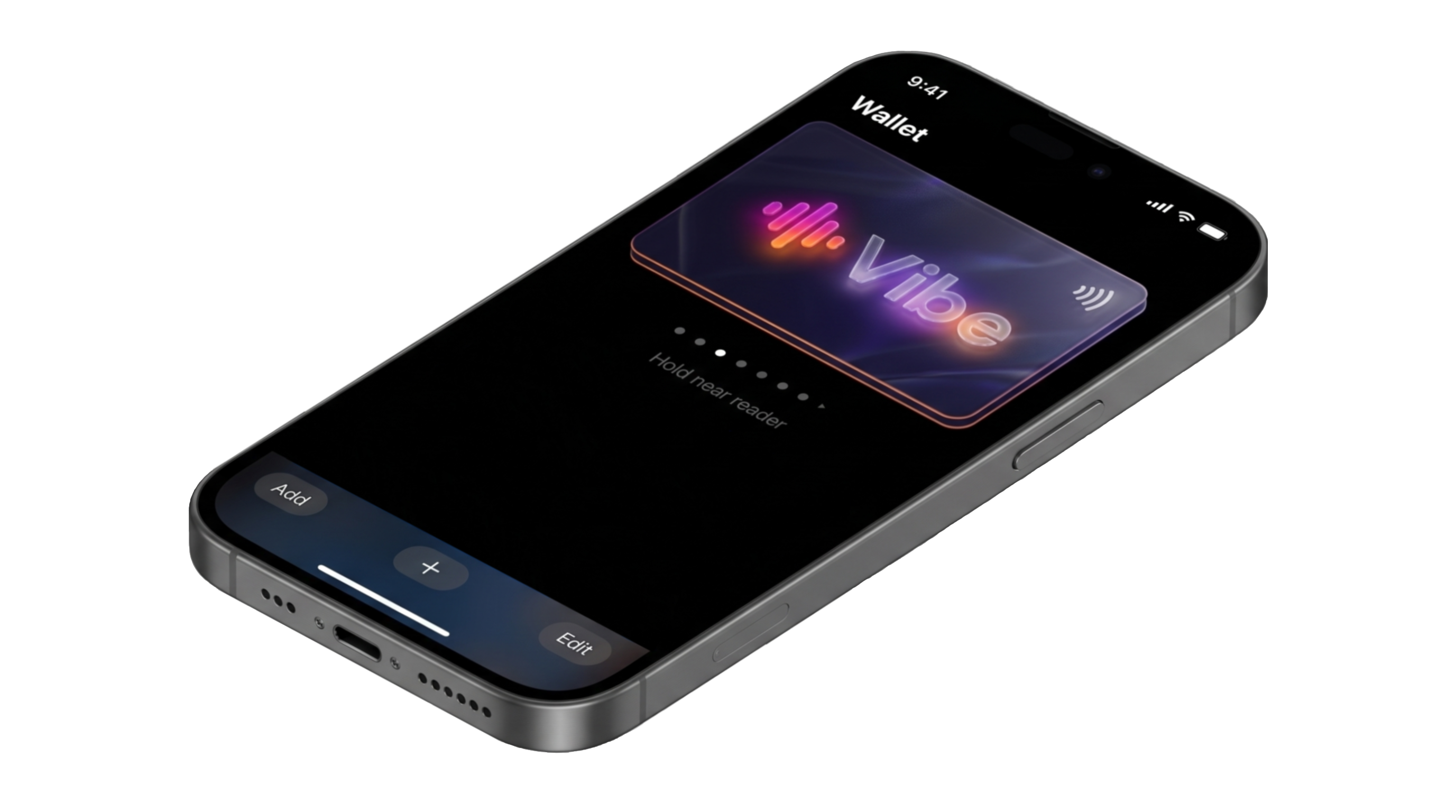
Vibe Card in Apple Wallet
Prepaid rail
Holds rewards, top-ups, gift card balances. Recaptures venue-funded rewards as interchange.
Credit rail
Optional. Standard interchange. For users who want a primary spend card tied to the platform.
Closes the loop
Every transaction ties identity to venue, time, basket, and sensor-verified presence. Clean ground truth.
07b · Challenges
SENSOR-VERIFIED

Behaviour you can buy.

Venue-sponsored · The Rooftop
$8 reward
Try the new spritz menu
Order one of 4 new drinks before midnight Friday
132 / 200 completed Verified by Card + sensor
Social
$12 reward
Bring 3 friends, mid-week
Tuesday or Wednesday, all four sensor-verified on site
Funded by venue Targets quiet nights
Discovery
$5 reward
Try a new venue tonight
Visit somewhere you've never been before, dwell 30+ min
Co-funded Drives net-new customer flow
Operators sponsor Challenges from the SaaS dashboard. Pay only for verified completions. Choose what behaviour to drive — quiet nights, new menu trial, group bookings, off-peak dwell.

What this means in dollars.

Move the sliders to model your venue. The calculator uses conservative assumptions drawn from comparable hospitality intelligence rollouts: a +12% lift in returner rate, +6% increase in average ticket on Card-holding customers, and +18% mid-week occupancy from sponsored Challenges.

Indicative only. Actual results vary by venue type, location, and baseline customer mix.

200
$55
5
Annual estimate
Baseline revenue
$2.86M
Estimated lift
+$418K
+12% returner rate +$172k
+6% average ticket (Card holders) +$103k
+18% mid-week occupancy (Challenges) +$143k
Net of platform fees
~$334K / year
Payback
3.2 months

How Vibe stacks up against
what venues already use.

Vibe POS analytics Door counter me&u / Spots Placer.ai
Live floor occupancy✓ zone-leveltotal onlydelayed estimate
Customer identity✓ verifiedcard token onlyorder-linkedaggregate
Spend per visit✓ tied to identityaggregateper-order
Marketing attribution✓ end-to-endlimiteddemographic only
Drive return visits✓ Challengesorder-driven
Customer-facing app✓ discovery + socialQR ordering only
Privacy approach✓ anonymous sensorsPCIanonymousPCImobile data
Hardware requiredsensors (we install)existing POSdoor deviceQR codesnone
Vibe is not a replacement for your POS or booking system — it's the layer that makes them all worth more by tying their data to who actually walked in.

The questions we get asked.

How much does it cost?
We charge a monthly platform fee scaled to venue size, plus a small per-completion fee on Challenges you choose to sponsor. Hardware is included in the platform fee — there's no upfront capex. Multi-venue groups receive volume pricing; we handle this on a per-conversation basis. Indicative range: $850–$2,800 per venue per month depending on floor size and feature tier.
How long is the contract?
Standard contract is 12 months with a 60-day exit clause if we don't deliver agreed minimum performance KPIs in the first 90 days. After year one, contracts roll month-to-month. Multi-venue contracts can be structured per-venue or as a master agreement.
What's the ROI timeline?
Pilot venues hit payback in 2–4 months on the platform fee alone, before factoring in Challenge-driven incremental revenue or marketing attribution savings. The ROI calculator above gives a rough estimate based on your venue size — happy to walk through a custom model in person.
Do I need to install hardware?
Yes — sensors are what make the data valuable. The good news: install takes ~4 hours, happens during off-hours, and requires no operational shutdown. Sensors mount discreetly to ceilings or walls and connect to existing WiFi (or a private mesh we install if your network can't carry it). Our team handles everything; you don't need internal IT involvement.
Will sensors disrupt my operations?
No service disruption. Sensors are passive — they emit no visible signal and don't require any action from staff or customers. They're smaller than a smoke detector and most operators report customers never notice them.
What kind of sensors are these, exactly?
A multi-modal stack: mmWave radar (presence + dwell), WiFi CSI (density + flow), Ultra-Wideband anchors (zone-level positioning), and BLE beacons (app handshake on entry). No cameras. No facial recognition. No personally identifiable measurement at the hardware layer — identity is only resolved when a customer voluntarily uses the app or Card.
What if my venue has bad WiFi or unusual layout?
We do a site walk before quoting. If WiFi is the bottleneck, we install a private sensor mesh that doesn't depend on your network. Unusual layouts (multiple floors, outdoor patios, basement venues) are handled by adjusting the sensor mix during the mapping phase.
Is this compliant with the Australian Privacy Act?
Yes. The sensor layer is anonymous by design — no personal information is captured at the hardware level. Identity only enters the system when a customer voluntarily uses the Vibe app or Card, at which point they have explicitly consented to data collection under our APP- compliant Privacy Policy. We're built on Australian-hosted infrastructure and follow Notifiable Data Breach scheme requirements.
Who owns the data?
You own all venue-specific data: your floor metrics, your customer analytics, your Challenge performance. We retain rights to aggregate, anonymised cross-venue benchmarks and to platform-level usage data. On contract exit, you receive a full export of your venue data in standard formats. No lock-in.
Can my customers opt out?
The sensor layer measures anonymous presence and is unaffected by opt-out (it doesn't identify individuals). For app and Card users, opt-out and data deletion are one-tap operations under standard consumer privacy controls. We've designed for transparency rather than friction — trust is the product.
Do you share my venue's data with competitors?
Never. Your venue-specific data is private to you. Aggregated, anonymised benchmark data (e.g. "average dwell across CBD wine bars") is shared in your dashboard so you can compare yourself to category peers, but no individual venue is ever identifiable in those views.
Does this integrate with my POS?
We have integrations with the major Australian hospitality POS systems (Lightspeed, Square, Tyro, Impos, Doshii). Integration is read-only and surfaces transaction data alongside sensor data in your dashboard. If you use a less common POS, we'll build the connector during onboarding — most are 1–2 week engineering jobs.
What about my booking system?
We integrate with the major booking platforms (SevenRooms, Now Book It, Resy, OpenTable). Bookings appear in the dashboard alongside walk-in volume so you can see conversion rates from booking → arrival → spend.
What if customers don't have the app?
The sensor layer measures everyone — app or no app. Customers without the app are counted in your floor analytics but obviously can't participate in Challenges or use the Card. App adoption grows organically in your venue once one or two customers are seen earning rewards. Most venues hit 15–25% app adoption within 3 months.
Can I export reports?
Yes — CSV, PDF executive summary, and API access depending on your tier. The platform also generates a weekly auto-report sent to your email summarising the most actionable insights for your venue.
What support do I get?
Every venue has a named account manager for the first 90 days. After that, support is via in-app chat (4hr response during business hours), email, and a phone line for hardware emergencies. Software updates and feature releases are handled silently — you'll see them appear in the dashboard with a release note.
What if a sensor fails?
Sensor health is monitored remotely. If a unit fails, we ship a replacement next-business-day at no cost during the contract term, and we have local install partners in major Australian cities for urgent swaps. Most sensor faults are caught and resolved before the venue notices.
Will this work for my type of venue?
The platform is purpose-built for hospitality venues with social dwell — bars, clubs, late-night restaurants, cocktail lounges, rooftop venues, breweries, live music venues. It's less suited to quick-service, drive-through, or venues where customer behaviour is purely transactional. We're transparent about this — if you're not a fit, we'll tell you on the first call.
Multi-venue rollout — how does that work?
We've designed the platform for groups from day one. Multi-venue accounts get a portfolio dashboard, cross-venue cohort analysis, group-level Challenge sponsorship, and consolidated billing. Rollout is staged: pilot with 2–3 venues first, then add the rest on a 30-day cadence. Volume pricing kicks in at 5+ venues.
See it
in your venue.

30-minute walkthrough. We come to you. Bring your operations manager, your marketing lead, and the questions we haven't answered yet.

Founded
Brisbane, Australia · 2026
Stage
Pre-seed · Pilot venues live